Sunday, August 9, 2026

Cercyonis identification

Wood nymphs (Cercyonis) seem to give a lot of people trouble so I thought I'd share some tips using illustrations from my Pocket Guide to the Butterflies of Washington (still available for $20 if you contact me privately via my email in the side bar). In addition to the three species we have in Washington (pegala, sthenele and oetus), silvestris occurs in Oregon and California, and meadii occurs in the Rockies down into Mexico. Cercyonis silvestris remains a bit of an enigma to me, it's sort of an indistinct version of sthenele with a bit of a pegala vibe, that's about all I can say about it at the moment. C. meadii on the other hand is quite distinct with its reddish coloration, and doesn't need much of an explanation. So let's look at the remaining three.

There are two key factors I look at first: the relative size of the two large eyespots on the forewing (FW), and the shape and definition of the ventral hindwing (VHW) median line.

First compare the eyespots: if the lower eyespot is larger than the upper one, it is almost always pegala, but in rare instances you may encounter a female sthenele with a slightly larger lower eyespot. If the lower eyespot is significantly smaller than the upper, it is usually oetus. If the eyespots are the same size, you're usually looking at either a male pegala or a female sthenele. If the lower eyespot is only slightly smaller than the upper, you may be looking at sthenele or a female oetus.

Now compare the VHW markings: the median line on oetus is very jagged (indicated with a blue line in my examples below) compared to the other species. However, it is not uncommon to find oetus without a defined median line, in which case the overall fine mottling, especially of the VFW, with no apparent two-toned coloration like we usually see in pegala and sthenele, makes it relatively easy to identify oetus in most cases. It is usually easy to identify pegala simply by its large size, but in photographs where that is hard to judge, one must compare the eyespots and wing markings. They often have somewhat of a flat affect similar to indistinct oetus, but unlike oetus, usually maintain a bit of a two-toned appearance between the outer and inner halves of the wings. Meanwhile, sthenele has a much less jagged median line compared to oetus, and usually a two-toned appearance between the outer and inner halves of the wings, similar to pegala but usually with more frosty appearance.

There are other slight differences, and of course regional variation across North America that isn't fully illustrated here with these WA examples, but I'll let the photos do the talking from here on. Nothing beats studying lots of photos to train your brain!


Wednesday, April 15, 2026

Butterflies of Oregon: an updated atlas


NOW AVAILABLE...if you are at all interested in the butterflies of Oregon, this is must-have book! It is jam-packed with information and extremely useful maps. For anyone familiar with the old Oregon Atlas by John Hinchliff (location dots on a Township grid map of Oregon), this is an exciting update. The new maps have a nice topographical background, the dots are color-coded by subspecies, and the dot locations have been modified to the actual locations as much as possible, making it very helpful for visualizing species distributions and to get a good idea of habitat. It is a 2-volume set sold by the lead author, Jeffrey C. Miller. Because it is self-published, it is only available through him, details below. As a self-publishing author myself, I know how hard (and expensive) it is to produce something like this. This 2-volume set is well worth the price!
Volume 1 contains single-page profiles of each butterfly species known to occur in Oregon, with a map showing dot records color-coded by subspecies, a representative dorsal and ventral photo of the species, and a short summary of information about it.
Volume 2 contains several map illustrations of geographical patterns, a number of maps with both butterfly and hostplant distribution records (much to my geography- and butterfly-rearing delight!) and so many other bits of information that I can't wait to read.

Volume 1 cover

Volume 2 cover
Here are the details:

VOLUME 1: Oregon Butterflies: An Updated Atlas Honoring John Hinchliff volume 1 Species Distributions.
Authors: Jeffrey C. Miller, Paul C. Hammond, Dana N.R. Ross, and Neil H. Bjorklund.
Date: 2026.
Contents: Species Pages, Nomenclature and ledgers.
Main features: all 177 of Oregon's butterfly species are each presented as 6x4.5 inch color dot-maps including subspecies and population segregates with current taxonomic epithets accompanied by 354 2x2 color images revealing dorsal and ventral aspects of the wings; appendix listing every subtaxon by County.
Format: 8x11.5 landscape layout, 11.5 font, soft cover, spiral binding, 218 pages+15 pages of front papers.

VOLUME 2: Oregon Butterflies: An Updated Atlas Honoring John Hinchliff volume 2 Synthesis.
Editors: Jeffrey C. Miller, Dennis A. Albert, and Paul C. Hammond.
Date: 2026.
Contents: A Virtual Road Tour To Explore Oregon Butterflies, Butterflies and Oregon's Environment, Counts of Butterfly Site Records, Ecoregions and Butterfly Distributions, Geographical Patterns of Shared Butterfly Distributions, Geographical Patterns In Species Richness of Oregon Butterflies, Caterpillar Foodplant Relationships. Appendices: number of records for nominate species and subtaxa, caterpillar and their foodplant Genera.
Main Features: 45 color dot-maps illustrating shared distributions and coincidence between butterfly caterpillar-foodplant geographical distributions.
Format: 8x11.5 portrait layout, 11.5 font, soft cover, spiral binding, 190 pages+9 pages of front papers.

Price: $95, includes volumes 1 & 2, not sold separately, both self-published by JCM.

To purchase, send Jeffrey C. Miller an email via the address oregonbutterflyatlas2026@gmail.com using subject line 'atlas inquiry' to receive an auto-reply email on how to order the 2-volume set of books.


Sample from Volume 1: Habrodais grunus species page

Sample from Volume 1: Pieris marginalis species page

Sample from Volume 1: Speyeria callippe species page


Sample from Volume 2

Sample from Volume 2: butterfly (large black dots) and larval food plant (small dots) records.

Sunday, March 29, 2026

Pocket Guide availability

Happy Spring!
I'm starting to get some requests for my Pocket Guide so just wanted to post a short update. The Washington Butterfly Association has some copies they will sell at select events, so that's one way to look for it. For individual purchases, I can take cash, check or PayPal, please contact me at the email in the info bar on the right of my blog for details.

Tuesday, October 14, 2025

NWB storefront closed until further notice

I have decided to close the NorthwestButterflies.com online store for the foreseeable future. It is becoming increasingly difficult and time-consuming to jump through all the hoops of managing the website and payment processing on top of my "regular life", especially when I only currently have one book to offer. I am retaining the domain name in case I decide to start up an online store again once I've had time to produce additional books. In the meantime, I still have plenty of Pocket Guides and bookmarks in stock that I will offer for sale at the occasional in-person meeting, or email me for purchase requests.

I apologize for the inconvenience, and very much appreciate the support over the last few years!

To be clear, this blog (northwestbutterflies.blogspot.com) isn't going anywhere, it's stress-free and doesn't cost anything. Please check back here for any updates.

Who knows, maybe I'll even get around to posting on here more often :)


Saturday, May 17, 2025

Snowberry Clearwing...or is it?

Few people know that the clear-winged little bumblebee sphinx moths (genus Hemaris) have dark scales covering their wings when they first emerge from the pupa. Even fewer people have ever had the chance to see this! Once the moth takes flight, they quickly shed all those loose scales. I have only seen this once, when I acquired two pupae and saw the newly-emerged adults, but I wasn't able to capture good photos of them. Yesterday, on a cool and cloudy day out at the Bald Hills southeast of Olympia (part of a multi-agency tour), I didn't expect to see any Lepidoptera. Looking down on a clump of plantain, I noticed a large black antenna and leg, which at first I thought might be a some kind of beetle. Upon closer examination I was thrilled to find this freshly emerged Snowberry Clearwing (Hemaris thetis). I couldn't find the pupal shell, it was probably well hidden under the thick moss. Larvae of this species, as the name implies, feed on snowberry bushes.

Snowberry Clearwing (Hemaris thetis) freshly emerged.

Snowberry Clearwing (Hemaris thetis) freshly emerged.

Snowberry Clearwing (Hemaris thetis) freshly emerged.

Snowberry Clearwing (Hemaris thetis) freshly emerged.

Snowberry Clearwing (Hemaris thetis) specimen showing the clear wings.


Bald Hills habitat with a patch of snowberry in the foreground.


Friday, November 22, 2024

Greeting Cards now available

The bookmarks have done so well so that I decided to try out another new product: blank greeting cards! Please check out my storefront at Northwest Butterflies for these and other items. Orders $35+ get free shipping!


Saturday, October 12, 2024

Now available!

 The new 4th Edition of the Pocket Guide to the Butterflies of Washington is now available to purchase on my sales site!

Also available are my new bookmarks showcasing a variety of butterflies from the Northwest:


Wednesday, September 4, 2024

NW Leps Workshop 2024

Just announced: the 45th annual NW Lepidopterists Workshop will be October 26-27th at the Oregon State University campus in Corvallis. It's free and any butterfly and moth enthusiasts are welcome!

For more information see here: https://osac.oregonstate.edu/events/45th-annual-pacific-northwest-lepidopterists-workshop

Saturday, March 2, 2024

Data and Databases

I've recently taken over as the Zone 2 (British Columbia, Idaho, Oregon, Washington) Coordinator for the Lepidopterists' Society Season Summary. With that has come many questions from people as I compiled my first report and have been learning the ropes. This post summarizes the public databases that include or are exclusively for records of Lepidoptera.

Simply defined, a database is a collection of data that is organized to facilitate the search and retrieval of that data. Prior to the digital age, such a database could consist of a card catalogue, or even a well-organized series of notebooks. With the advance of digital technology, the number and usage of online databases has increased over the past twenty years. In particular, when analyzing large downloads of butterfly data, I've noticed a trend of the number of modern records beginning to sharply increase around 2013, which is roughly when iNaturalist and eButterfly began to catch on.

There are four sites to which users may submit Lepidoptera records online:

BAMONA began in 1995 as two sites, Butterflies of the U.S. and Moths of the U.S., which were merged and relaunched in 2006 as Butterflies and Moths of North America. Users can submit their photos for verification or identification. Records are shown as orange dots on a Google basemap, with historic records (usually center points of counties, indicating occurrence somewhere in the county) shown as purple dots. Currently it hosts over 953,000 verified records of butterflies and moths.

BugGuide was launched in 2003 and is hosted by Iowa State University. It is structured to assist in species identification via a clickable guide, browsing photos by taxa, or by submitting photos as an "ID request". People may also submit any of their observations to the website. It currently hosts over 200,000 records of butterflies and moths, and many more of other Arthropods. Photos from verified submissions of moths on BugGuide are (with permission) sometimes copied to the Moth Photographers Group site.

iNaturalist began as a Master's project at UC Berkeley in 2008, eventually becoming an initiative of the California Academy of Sciences in 2014, and turned into an independent non-profit organization in 2023. It currently hosts over 2.5 million "research grade" records of butterflies and moths.

eButterfly also began as a graduate student's idea around 2010, forming in 2011 and initially launching in 2012 as a Canadian program, eventually expanding across North America. It is beginning to grow worldwide and currently hosts over 530,000 observations of butterflies.

Two databases compile data from most other online databases, in addition to many other sources, such as collections or smaller project-based sources. The Symbiota Collections of Arthropods Network (SCAN), as the name implies, is limited to Arthropod records only. It currently hosts over 33.7 million records for 238,000 species. The Global Biodiversity Information Facility (GBIF) contains most, if not all, of the same records fed into SCAN, but also contains data for all species, not just Arthropods. It currently hosts over 2.6 billion records. Many museum and university collections, and even some private ones, load their specimen data into these databases. The contributing collections are largely determined by which ones can obtain funding to support the digitization of their collections (it takes a lot of man-hours!).

BugGuide, iNaturalist, and eButterfly all load their "verified" or "research grade" records to SCAN and GBIF. BAMONA is not set up to do this, so any records submitted there will only be visible through that site, although researchers may submit data requests to the site.

Another way to submit public records is through The Lepidopterists' Society Season Summary ("SS"). This is an annual summary of butterfly and moth records in North America that has been in existence ever since the Society started in 1947. Any county or state records and other notable observations are printed in the annual summary that is sent to members, while all submitted data, printed or not, is curated and loaded into SCAN (some has also been loaded to BAMONA). It is up to you whether you want to submit a full report of all your observations for the year, or only a selection. The Zone Coordinator will select which records will be printed. Observations submitted to other databases (iNaturalist, BAMONA, etc.) can also be submitted to the SS, but to avoid an abundance of duplicate records in SCAN, the Coordinator will only submit a selection of these records. For example, if an observation on iNaturalist is determined to be a new state or county record, or is a species that hasn't been seen in a particular location for a long time, it can go into the SS to make it visible to a wider audience and document the special record. 

Some other items to note about submissions:

  • You do not have to be a member of LepSoc to submit records to the SS.
  • Any records submitted are not private: they will be loaded to SCAN, from which anyone can search, view, and download data.
  • There is a delay in uploading to SCAN: currently records up to about 2020 are loaded.
  • The Zone Coordinator can give you their preferred methods for submitting data to them. It is highly recommended to use an Excel spreadsheet, and a preformatted file can be downloaded from the LepSoc SS page (linked above). I have a slightly different spreadsheet format I like to use for sorting and curating data, and can email that to you upon request.
  • You do not have to submit any photos with your records, but the Coordinator may request to see a photo of a particular record to verify the correct identification.
If you wish to share your data publicly but aren't sure which site is right for you, ask yourself some questions:
  • Do you only photograph butterflies and often make multiple observations along a path or general area? eButterfly might be the site for you.
  • Do you wish to report moths (with or without butterflies)? iNaturalist or BAMONA are probably for you.
  • Do you enjoy the ability to interact with multiple experts and peers commenting on your observations, but don't mind if some of your posts don't get consistently verified? Try iNaturalist (eButterfly has started doing something similar as well).
  • Do you like to report species in addition to Lepidoptera? Try iNaturalist or BugGuide.
  • If you don't want to take the time to post individual observations with photos, and prefer to type up all your records in Excel, try the SS.
  • Do you want to submit to the SS but also like to post on one of the other sites? That's okay! Just recognize that the Coordinator will only use any that are particularly notable, but you don't have to make that decision. Simply put a link to each of your records into a Comments column when you type up your records to send to the Coordinator, that way they can easily verify your records and select which ones should go into the SS.

If you have any questions about the SS, please feel free to contact me; my email is in the left panel of this website.

Friday, October 6, 2023

Updates

I just updated two of the static pages in the menu on the left:

Collecting & Rearing Supplies - added a few new sources and updated comments.

Collecting & Mounting Specimens - finally got around to adding a bunch of photos that my mom took for me way back in 2018 (yeah, I'm waaay behind...) demonstrating how I rehydrate and spread specimens. These are in addition to the original photos that aren't great quality (taken with an iPod, remember those?) but are still useful in showing how I deal with different sizes of paper strips. I also added a detailed section on how to rehydrate specimens.

Keep up the comments and emailing me suggestions, I do get around to things eventually!

Saturday, April 1, 2023

Echo Azure vs. Brown Elfin

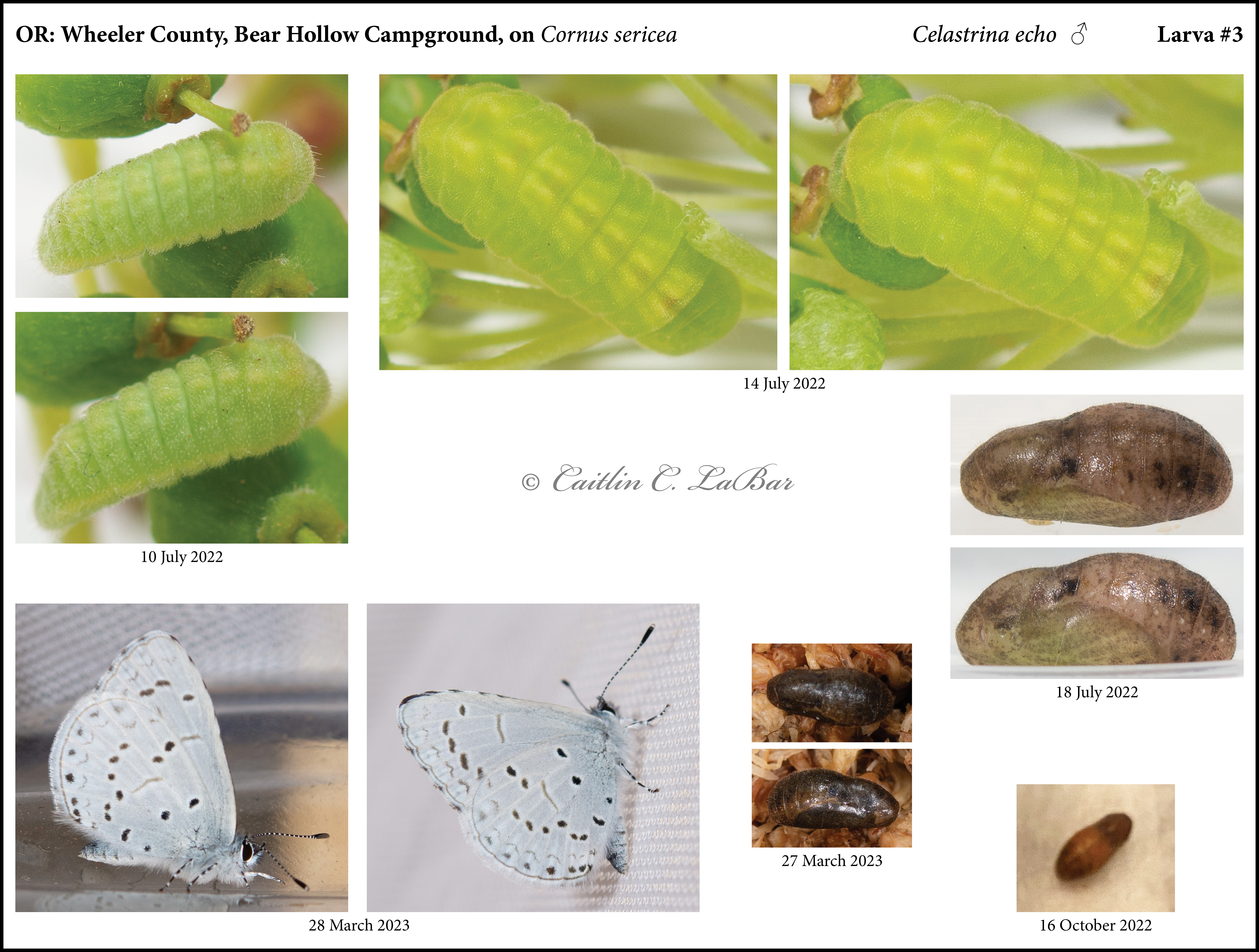
Last summer while hunting for Asher's Blues (Celastrina asheri) in eastern Oregon, I collected six larvae from red osier dogwood (Cornus sericea) flowers at Bear Hollow Campground southeast of Fossil in Wheeler County, Oregon. I was hopeful that they might be asheri: the larvae were mostly green compared to the (usually) heavier-marked Celastrina echo (see my article for more examples). Shortly after bringing them home, one of the larvae started to stand out to me as "odd", it had two pink-brown spots in an odd location and was noticeably shiny compared to the velvety-matte appearance of the others. Searching through James & Nunnallee's Life Histories of Cascadia Butterflies, I found a similar-looking larva: Callophrys augustinus, the Brown Elfin! However, osier dogwood was not listed as a known larval food plant, which I soon verified from Dave Nunnallee and Jonathan Pelham that it had never been recorded for augustinus. As the larva grew, it developed an even more striking pattern, had large, raised bumps on each segment, and maintained a very shiny appearance. The pupa was also different: a wider abdomen, solid dark brown color, and not shiny, compared to the "skinny" and shiny, honey-brown colored pupae of Celastrina. The puzzling bit was that one other larva produced an identical pupa, yet that larva had been one of the least-marked larvae of the six. This led me to second-guess myself and wonder if perhaps these two were just a variation of echo or asheri, or if in fact both were augustinus exhibiting a different larval morph, possibly due it using osier dogwood.

All larvae were found on osier dogwood flowers, which were at a stage where they were just beginning to lose petals on some flower heads. I continued to feed the larvae on osier dogwood flowers and young seed pods until they pupated. Because there were only six larvae, I kept track of them all the way through by numbering 1 through 6. 

Celastrina echo (1, 3, 5, 6) and Callophrys augustinus (2, 4) pupae in October 2022.

Most of my rearing experience is with Saturniidae, cocoons and pupae of which usually do well with only occasional misting through the winter. However, my experience rearing Celastrina asheri last year resulted in only about 50% adult emergence and almost half of those never fully expanding their wings. I had overwinter those between paper towels which I misted with water a few times through the winter. The temperature and humidity sensor I keep with all my overwintering pupae was usually between 30-50% humidity, only rising to around 60% for a couple days when they were misted. I started thinking about what happens in the wild, that Celastrina pupae overwinter in the leaf litter, usually buried under snow, and must become completely drenched during the spring snowmelt. In comparison, cocoons and some butterfly pupae (like swallowtails) tend to be attached to twigs or in cracks of bark and are more exposed to the elements but are never completely submerged. So for this round of overwintering, I wanted to construct something that would more closely mimic consistently damp leaf litter while also being free of parasites (i.e. not using regular potting soil or wild leaf litter). Remembering that some lepidopterists have used bricks or clay pots for overwintering, which help regulate temperature and humidity, I came up with a plan. I used a clean clay pot tray, filled it half way with orchid mix (small bark chips and perlite used for potting orchids), then fashioned a cardboard separator which I taped to the edge of the clay pot using gorilla tape. I then covered the bark with wet sphagnum moss which I had previously soaked in another container (it comes in dry, sterile packages for gardening and craft use). I placed the tray into a slightly bigger plastic plant tray and packed more wet sphagnum moss into the space around the edge. This was to help the clay pot stay damp longer rather than evaporating out through the bottom. Initially I also placed part of a paper towel in each section so I wouldn't lose the pupae down into the sphagnum moss (see photo above), but within a month it started to mold so I removed it and just carefully placed each pupa in a spot where it wouldn't fall into a larger space. I loosely covered the tray with a folded hand towel to help with temperature and humidity regulation, then put everything into a small mesh bug cage on my north-facing balcony in late October.

Overwintering tray during construction

The temp/humidity sensor was kept next to the tray under the towel. The relative humidity fluctuated with the temperature but was fairly steady between 50-70% all winter. Whenever it started staying around 50% or less, I added 1/4 to 1/2 cup of water around the edge of the tray. This happened maybe 3-4 times through the winter. Once I accidentally spilled a bunch of water into the tray to the point where all the pupae were floating. I thought for sure this whole thing was a stupid idea and I had just drowned them and wouldn't get anything to emerge. I poured off a little of the excess water but left the rest to soak into the moss. Another time during the winter, the temperatures dipped down to 17F, which is very cold for my SW WA area. With difficulty I resisted bringing the cage inside overnight, all the while thinking that for sure they would freeze those two or three days, but reminding myself that they came from a very cold part of Oregon and had to be able to survive temperatures even lower, even if they were insulated under several feet of snow all winter.

In early March I rolled the towel over to the side just in case anything decided to pop out on a warm day. With the spring flowers finally blooming and a couple days of 60F weather (and reports of a wild Celastrina echo being spotted in NW Washington), I got impatient and brought the cage inside ahead of the next several days of cool and rainy weather. Three days later three of the six emerged, quickly followed by the rest over this past week. All my fears were relieved and the identity of species revealed! Four Celastrina echo and two Callophrys augustinus, confirming a new larval food plant record for augustinus! Click on the images to view at full screen.

Larva 1: Celastrina echo, female

Larva 3: Celastrina echo, male

Larva 5: Celastrina echo, female

Larva 6: Celastrina echo, female

Larva 2: Callophrys augustinus, male

Larva 4: Callophrys augustinus, female

Reviewing the limited images of augustinus larvae, there are a few examples of solid green larvae, all from California and Arizona:

https://www.inaturalist.org/observations/2723370

https://www.inaturalist.org/observations/89286157

https://www.inaturalist.org/observations/2717237

http://butterfliesofamerica.com/L/imagehtmls/LycRio/Callophrys_augustinus_annettae_larva_Pima_Co_AZ_USA_6-IV-02_JPB_i.htm

http://butterfliesofamerica.com/L/imagehtmls/LycRio/Callophrys_augustinus_iroides_5th_instar_larvae_from_one_female_Otay_Mountain_San_Diego_Co_CA_USA_06-VI-2008_KOJI_i.htm


One of the keys to telling apart Celastrina larvae from Callophrys augustinus is their head color: the former is always dark brown, almost black, and the latter is always pale brown. This should have been a clue early on but I didn't notice it on Larva #2 until I reviewed my photos much later. Another marker I noticed, that so far seems fairly consistent in images I've studied, is that the augustinus larvae have a dark patch in the center of the fold just above their head. Celastrina may have a dark marking on either side of that same segment but it always seems to be lighter in the center, essentially a reverse from augustinus. These and other identification markers are described in the following images.

Celastrina have a dark brown head (left) and no dark patch in the center of the segment above the head, while augustinus are the reverse: a pale brown head and a dark patch on the first segment.

Segments on Celastrina larvae tend to be flattened with an indentation in the middle (a, b), although mature larvae may have more rounded segments (c). They also always have a very velvety appearance (b, c). Callophrys augustinus larvae tend to have prominently-raised bumps on each segment, giving them a more ridged appearance. They also often have a shiny appearance (e, f) but this may not be as noticeable in some color forms (d).

The relatively smooth segments of Celastrina larvae compared to the ridged appearance of augustinus is best seen in the pre-pupal stage, such as those shown here.

Celastrina pupae are shiny and start out as a rose- or honey-brown color with varying amounts of black speckles and patches, compared to augustinus pupae which are solid dark brown, not shiny, and tend to be more robust or "fatter" than Celastrina pupae (this is most notable in the photo of all six pupae at the beginning of this post). Note that the augustinus pupa shown here is post-emergence with the crack visible from where the adult emerged. However, the pupa did not noticeably change color from before the emergence, compared to Celastrina pupae which noticeably darken (bottom left) prior to emergence and then are somewhat transparent after the adult emerges.

In summary, while a sample size of six is rather small to confidently say this overwintering method was a raging success, I will definitely be employing it in the future and look forward to better success rearing Celastrina asheri the next time around!

Saturday, March 18, 2023

Free shipping discount on NWB

Pop over to my sales website at NorthwestButterflies.com to take advantage of a temporary offer: to celebrate Spring, enter discount code SPRING23 during checkout to receive a free shipping discount on your order! From March 18 through April 30 only.

Also remember that if you purchase the Butterflies of the Sinlahekin Wildlife Area (either the normal cover or gray cover), you will receive an automatic discount of 20% off a Pocket Guide when you add both to your cart. There are only 2 "normal cover" and 13 "gray cover" BSWA books left, so get one before they're gone! I had so much trouble publishing the BSWA the first time around, and printing costs have skyrocketed since then, so I probably will never be able to republish in print. I'm still investigating the digital book process but it will be some time before I update everything if I go that route.

The species names used in these books are a little out of date, so be sure to also grab a copy of the Summary of Washington Butterflies checklist available for free download here, last updated 3/6.

Thanks for your support!


Thursday, April 28, 2022

Introducing a new butterfly species: Asher's Blue

For the last few decades, lepidopterists in the west have been uncertain how to classify a variably-marked group of Celastrina (azure butterflies) in the Columbia River watershed. Until now, only two species were known in this area: Celastrina echo and Celastrina lucia. Individuals from east of the Cascades were often lumped with echo but some from Yakima and Kittitas counties were thought to be lucia. However, neither arrangement quite fit and some started questioning if there might actually be a third species involved. In the past 2-3 years, with the help of many regional butterfly enthusiasts, some breakthroughs occurred which I started investigating with two of our regional Celastrina experts. I am excited to present our findings!

Read the journal article here: https://zenodo.org/record/6502157

Celastrina asheri, Asher's Blue, a new butterfly species in western North America.

Range map of Celastrina asheri compared with C. echo and C. lucia.

Thursday, February 17, 2022

BioQuip closing...what to do now

Update 3/18/23: a new business has started up and is slowly building their inventory. Keep an eye on EcologySupplies.com!

BioQuip announced last week that they are closing the business on March 11, due to a "perfect storm" of several reasons. They have been the primary supplier of insect collecting and rearing supplies to universities, museums and private researchers in the USA since 1947. I've been a happy customer for going on 20 years. Ever since I heard the announcement, I have been researching numerous websites for alternative sources of the supplies I've relied on from BioQuip over the years. A permanent page link can be found on the left side of my blog: Insect Collecting & Rearing Supplies

Some items are easy to find elsewhere but less convenient because of having to purchase from multiple sources. Other items are either difficult to find or you have to figure out an alternative name to search for, as some items marketed for butterfly collecting have other names in the craft stores or chemical supply companies.

If any of you are able to purchase from these places and feel like sharing your experience please send me an email (contact at left). I will try to keep the page updated with the best places to purchase supplies and any tips that I can come up with.

Sunday, June 27, 2021

Epic Okanogan Trip

I recently spent several days in Okanogan County, Washington. It was a glorious and highly productive trip with 72-73 species over the entire vacation, including two new to me (Polites themistocles and P. peckius) and two I hadn’t seen in around ten years (Boloria selene and B. bellona). This was only the second time in my life I’ve visited Moses Meadows, which I did twice on this trip. I also spent a lot more time exploring the higher elevation areas west of the Sinlahekin, which yielded a few more data points for Boloria freija, including the surprise of finding a female at Salmon Meadows! Freija has never been recorded there, a heavily surveyed location in WA.

A few things to note about the following list:
  • I grouped some locations into general areas with elevation ranges to help shorten this long list. Detailed data with coordinates were sent to Jon Pelham for the WA database.
  • Quantities with male or female indicate individuals verified by catch/released or collected, or occasionally those seen closely or obviously dimorphic (like blues).
  • Numbers with “unk” indicate those seen clearly but not caught.
  • Species with no number are those where at least one was seen but I forgot to write down a total count or otherwise can’t remember how many there were in that spot.
  • Numbers greater than 10-20 are mostly estimates.
  • Taxonomy is per the Pelham Catalogue (plus segregates for finer resolution of some).
  • Regarding the question marks on Celastrina “lucia” and “echo” larvae found at the Sinlahekin, these and other potential C. lucia are currently being studied by me and others in WA. I won’t go into all the details here, but due to a few factors we are questioning if C. lucia may actually occur at the Sinlahekin and a few other sites in WA. I am rearing several larvae to help investigate this and will post more about it at a later time.

June 12, 2021

Kittitas County, WA: Ringer South Trail, Ringer Loop Rd, elev 1430'
Euphilotes columbiae (Columbia Blue) 2♂
Phyciodes mylitta mylitta (Mylitta Crescent) 1♂


June 13, 2021

Grant County, WA: Gas station in Grand Coulee at Hwy 155 and 174, elev 1490'
Sphinx drupiferarum (Wild Cherry Sphinx) 1♂


Sphinx drupiferarum (Wild Cherry Sphinx), waiting for me at a gas station in Grand Coulee, WA


It was fairly cloudy with only intermittent sun this day, so total butterflies were low.

Okanogan County, WA: Lyman Lake-Moses Mountain Road, elev 3860'-4040'
Erynnis icelus (Dreamy Duskywing) 11♂
Erynnis persius Cascadian seg. (Persius Duskywing) 6♂
Colias interior (Pink-edged Sulphur) 1♂
Callophrys eryphon Columbia Basin seg. (Western Pine Elfin) 3 unk
Icaricia saepiolus rufescens (Greenish Blue) 10♂
Euphydryas anicia Okanogan Highlands seg. (Anicia Checkerspot) 4♂
Chlosyne palla blackmorei (Northern Checkerspot) 1♂
Phyciodes pulchella owimba (Field Crescent) 3♂
Coenonympha california columbiana (Ochre Ringlet) 1♂
Erebia epipsodea epipsodea (Butler's Alpine) 1♂ 1♀

Okanogan County, WA: Moses Meadows, edges along loop road, elev. 3470'-3600'
Colias eriphyle (Eriphyle's Sulphur) 1♂
Icaricia icarioides pembina (Boisduval's Blue) 1♂
Euphydryas anicia Okanogan Highlands seg. (Anicia Checkerspot) 1♂
Coenonympha california columbiana (Ochre Ringlet) 1♂


Southwest corner of Moses Meadows, Okanogan County, WA

Okanogan County, WA: Salmon Meadows, vicinity of S end, elev 4460'-4480'
Anthocharis julia sulfuris (Julia Orangetip) 1♀
Euchloe ausonides transmontana (Large Marble) 3♂
Callophrys sheridanii newcomeri (Sheridan's Green Hairstreak) 1♀ 1 unk
Glaucopsyche lygdamus columbia (Silvery Blue) 1♂ 1♀ 20 unk
Euphydryas anicia Okanogan Highlands seg. (Anicia Checkerspot) 15♂
Coenonympha california ampelos (Ochre Ringlet) 2 unk
Erebia epipsodea epipsodea (Butler's Alpine) 1♀ 1 unk


Salmon Meadows (looking north), Okanogan County, WA


Salmon Meadows (looking west), Okanogan County, WA


Callophrys sheridanii newcomeri (Sheridan's Green Hairstreak) at Salmon Meadows


June 14, 2021
Too cloudy and cool (big thunderstorms the night before) for butterflies except the occasional swallowtail, so spent the day checking out conditions around the Sinlahekin and taking some landscape photos.


Dogbane going crazy in a thinned and prescribed burned area on the Sinlahekin Wildlife Area


Conners Lake, Sinlahekin Wildlife Area


View north from Jay Hill Camp, Sinlahekin Wildlife Area


Sinlahekin Creek, Sinlahekin Wildlife Area


June 15, 2021
Still chasing the sun this day, but conditions improving, and the mud left from all the thunderstorms was attracting more butterflies!

Okanogan County, WA: Sinlahekin Wildlife Area, NE Fish Lake, elev 1800'
Pterourus multicaudata pusillus (Two-tailed Tiger Swallowtail) 1♂

Okanogan County, WA: Sinlahekin Wildlife Area, vicinity of NW Fish Lake, elev 1790'-1820'
Erynnis icelus (Dreamy Duskywing)
Polites themistocles turneri (Tawny-edged Skipper) 2♂
Amblyscirtes vialis (Common Roadside Skipper) 1♂
Pterourus multicaudata pusillus (Two-tailed Tiger Swallowtail)
Pterourus rutulus (Western Tiger Swallowtail)
Pterourus eurymedon (Pale Tiger Swallowtail)
Icaricia lupini lutzi (Lupine Blue) 1♂
Icaricia icarioides pembina (Boisduval's Blue)
Limenitis lorquini burrisonii (Lorquin's Admiral)
Coenonympha california ampelos (Ochre Ringlet) 1♂


Polites themistocles turneri (Tawny-edged Skipper), my very first one!

Okanogan County, WA: Sinlahekin Wildlife Area, meadows N of Conners Lake, elev 1490'-1500'
Polites themistocles turneri (Tawny-edged Skipper) 5♂ 1♀ 15 unk
Boloria selene Pacific NW seg. (Silver-bordered Fritillary) 2♂
Phyciodes cocyta pascoensis (Northern Crescent) 2♂
Coenonympha california ampelos (Ochre Ringlet) 5 unk


Seasonally moist meadows north of Conners Lake, where Polites themistocles and Boloria selene are found.

Okanogan County, WA: Sinlahekin Wildlife Area, upper canyon, elev 2300'-2770'
Amblyscirtes vialis (Common Roadside Skipper) 1♂
Anthocharis julia sulfuris (Julia Orangetip) 2♂
Euchloe ausonides transmontana (Large Marble) 3♂
Euphilotes heracleoides (Cascadia Blue) 10♂
Icaricia lupini lutzi (Lupine Blue) 2♂
Icaricia icarioides pembina (Boisduval's Blue) 15♂
Argynnis zerene picta (Zerene Fritillary) 1♂
Limenitis lorquini burrisonii (Lorquin's Admiral) 2 unk
Aglais milberti subpallida (Milbert's Tortoiseshell) 1 unk
Nymphalis antiopa antiopa (Mourning Cloak) 1 unk
Phyciodes pulchella owimba (Field Crescent) 1♂

Okanogan County, WA: Sinlahekin Wildlife Area, between Forde and Blue lakes, elev 1620'
Pterourus multicaudata pusillus (Two-tailed Tiger Swallowtail) 1 unk
Pterourus rutulus (Western Tiger Swallowtail) 2 unk
Pterourus eurymedon (Pale Tiger Swallowtail) 5 unk
Tharsalea heteronea klotsi (Blue Copper) 2♂
Argynnis zerene picta (Zerene Fritillary) 1♂
Drasteria ochracea (moth) 1♀

Okanogan County, WA: Sinlahekin Wildlife Area, vicinity of Hunter's Camp, elev 1750'-1800'
Tharsalea heteronea klotsi (Blue Copper) 1♂

Okanogan County, WA: Salmon Meadows, vicinity of N end, elev 4480'
Anthocharis julia sulfuris (Julia Orangetip) 1♂ 1♀
Euphydryas anicia Okanogan Highlands seg. (Anicia Checkerspot) 3♀ 40 unk
Schinia honesta (Black-spotted Gem moth) 1 unk

Okanogan County, WA: Salmon Meadows, vicinity of S end, elev 4460'-4480'
Euphydryas anicia Okanogan Highlands seg. (Anicia Checkerspot) 10♂ 30 unk


Euphydryas anicia Okanogan Highlands seg. (Anicia Checkerspot, males) at Salmon Meadows


Euphydryas anicia Okanogan Highlands seg. (Anicia Checkerspot, female) at Salmon Meadows


June 16, 2021

Okanogan County, WA: Sinlahekin Wildlife Area, Blue Lake Pothole 2, elev 1720'
Polites themistocles turneri (Tawny-edged Skipper) 1♂
Tharsalea helloides (Purplish Copper) 2♂ 2♀
Coenonympha california ampelos (Ochre Ringlet) 3 unk

Okanogan County, WA: Sinlahekin Wildlife Area, upper canyon, elev 2300'-2770'
Erynnis icelus (Dreamy Duskywing) 1♂
Erynnis persius Cascadian seg. (Persius Duskywing) 1♂
Hesperia colorado idaho (Western Branded Skipper) 1♂
Amblyscirtes vialis (Common Roadside Skipper) 2♂
Pterourus multicaudata pusillus (Two-tailed Tiger Swallowtail) 4+ unk
Pterourus eurymedon (Pale Tiger Swallowtail) 5+ unk
Euphilotes heracleoides (Cascadia Blue) 1♂
Celastrina echo [?] (Echo Azure) 1 larva on red osier dogwood (rearing, strongly patterned like typical echo)
Celastrina lucia [?] (Lucia Azure) 13 larvae on red osier dogwood (rearing, look identical to Ringer Loop lucia larvae)
Icaricia lupini lutzi (Lupine Blue) 1♂
Icaricia icarioides pembina (Boisduval's Blue) 12♂
Limenitis lorquini burrisonii (Lorquin's Admiral) 3 unk
Nymphalis californica californica (California Tortoiseshell) 2 unk
Nymphalis antiopa antiopa (Mourning Cloak) 1 unk
Euphydryas anicia Okanogan Highlands seg. (Anicia Checkerspot) 1 unk
Coenonympha california ampelos (Ochre Ringlet) 1 unk


Celastrina lucia? larva, approximately 2nd instar


Celastrina lucia? larva, 4th (final) instar


Celastrina lucia? larva, 4th (final) instar


Celastrina lucia? larva, showing rosy coloration prior to pupating

Okanogan County, WA: Upper Sinlahekin Creek road junction, 1 mile W of SWA, elev 3100'
Hesperia colorado idaho (Western Branded Skipper) 1♂
Papilio zelicaon (Anise Swallowtail) 1♂
Pterourus rutulus (Western Tiger Swallowtail) 3♂
Cupido amyntula amyntula (Western Tailed Blue) 1♂
Icaricia icarioides pembina (Boisduval's Blue) 5 unk
Nymphalis californica californica (California Tortoiseshell) 10 unk
Nymphalis antiopa antiopa (Mourning Cloak) 1 unk
Coenonympha california ampelos (Ochre Ringlet) 5 unk

Okanogan County, WA: Upper Sinlahekin Creek Rd at gate, elev 3800'
Pyrgus ruralis ruralis (Two-banded Checkered Skipper) 1 unk
Erynnis persius Cascadian seg. (Persius Duskywing) 1♂
Argynnis callippe semivirida (Callippe Fritillary) 1♂
Nymphalis californica californica (California Tortoiseshell)
Phyciodes pulchella owimba (Field Crescent) 1♂
Coenonympha california ampelos (Ochre Ringlet)

Okanogan County, WA: Bald Butte Rd at large rock outcrop, elev 3830'
Parnassius smintheus magnus (Mountain Parnassian) 1♂
Cicindela longilabris (Boreal Long-lipped Tiger Beetle) 1 unk

Okanogan County, WA: Bald Butte Rd at wet seepy area, elev 4410'
Pyrgus ruralis ruralis (Two-banded Checkered Skipper) 2 unk
Icaricia saepiolus rufescens (Greenish Blue) 1♂
Boloria epithore chermocki (Western Meadow Fritillary) 1♂
Phyciodes pulchella owimba (Field Crescent) 1♂
Coenonympha california ampelos (Ochre Ringlet) 2 unk

Okanogan County, WA: FR-3820 seep and hillside meadow, 2.75mi NW of Salmon Meadows, elev 5600'-5640'
Erynnis icelus (Dreamy Duskywing) 1♂
Papilio zelicaon (Anise Swallowtail) 6♂
Callophrys sheridanii newcomeri (Sheridan's Green Hairstreak) 2♂
Glaucopsyche lygdamus columbia (Silvery Blue) 10♂
Nymphalis antiopa antiopa (Mourning Cloak) 1 unk
Polygonia gracilis zephyrus (Hoary Anglewing/Comma) 3 unk
Euphydryas anicia Okanogan Highlands seg. (Anicia Checkerspot) 5 unk
Phyciodes pulchella owimba (Field Crescent) 3♂
Coenonympha california ampelos (Ochre Ringlet)
Erebia epipsodea epipsodea (Butler's Alpine) 3♂
Oeneis chryxus chryxus (Chryxus Arctic) 8♂ 1♀

Okanogan County, WA: FR-3820, vicinity of area N of Lone Frank Pass, elev 6630'-6600'
Colias eurytheme (Orange Sulphur) 1♀
Glaucopsyche lygdamus columbia (Silvery Blue) 20♂ 20 unk
Boloria freija freija (Freija Fritillary) 4♂ 14 unk
Polygonia gracilis zephyrus (Hoary Anglewing/Comma) 2♂ 9 unk


Hairpin curve north of Lone Frank Pass where Boloria freija are found, Okanogan County, WA


June 17, 2021

Okanogan County, WA: Toats Coulee Rd overlook, elev 4500'
Hesperia nevada N Great Basin & Columbia Basin seg. (Nevada Skipper) 3♂ 1♀
Glaucopsyche piasus toxeuma (Arrowhead Blue) 1♀ 1 unk
Icaricia icarioides pembina (Boisduval's Blue) 5♀
Argynnis callippe semivirida (Callippe Fritillary) 8♂
Nymphalis californica californica (California Tortoiseshell) 1 unk
Coenonympha california ampelos (Ochre Ringlet) 3 unk


Toats Coulee Road overlook where Hesperia nevada were found


Glaucopsyche piasus toxeuma (Arrowhead Blue) female

Okanogan County, WA: Toats Coulee Road at various seeps below Middle Fork, elev 4730'-5000'
Pterourus rutulus (Western Tiger Swallowtail) 1 unk
Anthocharis julia sulfuris (Julia Orangetip) 3♂
Euchloe ausonides transmontana (Large Marble) 1♂
Callophrys eryphon Columbia Basin seg. (Western Pine Elfin) 1 unk
Euphilotes heracleoides (Cascadia Blue) 2♂
Glaucopsyche piasus toxeuma (Arrowhead Blue) 1♂
Glaucopsyche lygdamus columbia (Silvery Blue)
Icaricia lupini lutzi (Lupine Blue) 1♂
Icaricia saepiolus rufescens (Greenish Blue) 10+♂
Icaricia icarioides pembina (Boisduval's Blue) 14♂
Boloria epithore chermocki (Western Meadow Fritillary) 4♂
Argynnis callippe semivirida (Callippe Fritillary) 6♂
Polygonia gracilis zephyrus (Hoary Anglewing/Comma) 1 unk
Euphydryas anicia Okanogan Highlands seg. (Anicia Checkerspot) 3♂ (1 aberrant)
Coenonympha california ampelos (Ochre Ringlet) 7 unk
Erebia epipsodea epipsodea (Butler's Alpine) 3♂
Hemaris thetis (Snowberry Clearwing moth) 1♂

Okanogan County, WA: Middle Fork Toats Coulee Creek at FR-39/Toats Coulee, elev 5000'
Erynnis persius Cascadian seg. (Persius Duskywing) 4♂
Hesperia juba (Juba Skipper) 1♂
Papilio zelicaon (Anise Swallowtail) 15♂
Colias eriphyle (Eriphyle's Sulphur) 1♂
Glaucopsyche lygdamus columbia (Silvery Blue)
Icaricia icarioides pembina (Boisduval's Blue)
Plebejus melissa melissa (Melissa Blue) 1♂
Argynnis coronis simaetha (Coronis Fritillary) 1♂
Polygonia gracilis zephyrus (Hoary Anglewing/Comma) 1♂ 100 unk
Oeneis chryxus chryxus (Chryxus Arctic) 1♀


Papilio zelicaon (Anise Swallowtail) puddle party at Middle Fork Toats Coulee

Okanogan County, WA: FR-39 roadside wet ditch just E of Long Swamp, elev 5520'
Erynnis persius Cascadian seg. (Persius Duskywing) 2♂ 1♀
Callophrys eryphon Columbia Basin seg. (Western Pine Elfin) 1♀
Cupido amyntula amyntula (Western Tailed Blue) 1♂
Boloria epithore chermocki (Western Meadow Fritillary)
Euphydryas anicia Okanogan Highlands seg. (Anicia Checkerspot) 1♀ 2 unk
Coenonympha california ampelos (Ochre Ringlet) 2 unk
Erebia epipsodea epipsodea (Butler's Alpine) 3♂

Okanogan County, WA: Long Swamp, campground/meadow, elev 5440'

Erynnis persius Cascadian seg. (Persius Duskywing) 20♂
Colias sp. 1 unk
Glaucopsyche lygdamus columbia (Silvery Blue) 30♂
Icaricia icarioides pembina (Boisduval's Blue) 1♂ 10 unk
Boloria epithore chermocki (Western Meadow Fritillary) 1♂
Nymphalis antiopa antiopa (Mourning Cloak) 20 unk

Okanogan County, WA: FR-39 at Corral Butte, elev 6480'

Nymphalis californica californica (California Tortoiseshell) 1 unk
Nymphalis antiopa antiopa (Mourning Cloak) 2 unk
Oeneis chryxus chryxus (Chryxus Arctic) 1 unk

Okanogan County, WA: FR-39 between Thirtymile Creek and Corral Butte, elev 5870'
Pyrgus ruralis ruralis (Two-banded Checkered Skipper) 1 unk
Erynnis persius Cascadian seg. (Persius Duskywing) 1♂ 3 unk
Anthocharis julia sulfuris (Julia Orangetip) 1♂
Glaucopsyche lygdamus columbia (Silvery Blue) 5♂ 8♀
Icaricia icarioides pembina (Boisduval's Blue) 1♂
Boloria epithore chermocki (Western Meadow Fritillary) 1♂
Nymphalis californica californica (California Tortoiseshell) 10 unk
Nymphalis antiopa antiopa (Mourning Cloak) 2 unk
Polygonia gracilis zephyrus (Hoary Anglewing/Comma) 1 unk
Euphydryas editha beani (Edith's Checkerspot) 2♀ 1 unk


In spite of the desolation from the wildfire around 2001, this area is recovering well with plenty of butterflies to show for it.

Okanogan County, WA: Thirtymile Meadows at FR-39, elev 6120'
Erynnis persius Cascadian seg. (Persius Duskywing) 3 unk
Glaucopsyche lygdamus columbia (Silvery Blue) 10♂
Boloria freija freija (Freija Fritillary) 3♂ 1 unk
Nymphalis californica californica (California Tortoiseshell) 1 unk
Nymphalis antiopa antiopa (Mourning Cloak) 2 unk

Okanogan County, WA: Twentymile Meadows Overlook on FR-39, elev 6460'
Glaucopsyche lygdamus columbia (Silvery Blue) 20♂
Euphydryas editha beani (Edith's Checkerspot) 11♂ 1♀ 30 unk

Okanogan County, WA: FR-39/FR-3820 intersection, elev 6320'
Glaucopsyche lygdamus columbia (Silvery Blue) 20♂
Boloria freija freija (Freija Fritillary) 1♂
Nymphalis antiopa antiopa (Mourning Cloak) 1 unk
Polygonia gracilis zephyrus (Hoary Anglewing/Comma) 1 unk

Okanogan County, WA: FR-3820, 0.5mi S of FR-39, elev 6510'
Euphydryas editha beani (Edith's Checkerspot) 3♂

Okanogan County, WA: FR-3820, vicinity of area N of Lone Frank Pass, elev 6630'-6600'
Glaucopsyche lygdamus columbia (Silvery Blue) 20♂
Boloria freija freija (Freija Fritillary) 1♂
Aglais milberti subpallida (Milbert's Tortoiseshell) 1 unk
Polygonia gracilis zephyrus (Hoary Anglewing/Comma) 10 unk
Euphydryas editha beani (Edith's Checkerspot) 3 unk
Euphydryas anicia Okanogan Highlands seg. (Anicia Checkerspot) 1♂

Okanogan County, WA: FR-3820, vicinity of area S of Lone Frank Pass, elev 6670'
Glaucopsyche lygdamus columbia (Silvery Blue) 20♂
Boloria freija freija (Freija Fritillary) 1♂
Phyciodes pulchella owimba (Field Crescent) 1♂


Looking southeast towards Conconully from a hillside a few miles northwest of Salmon Meadows

Okanogan County, WA: Salmon Meadows, vicinity of S end, elev 4460'-4480'
Boloria freija freija (Freija Fritillary) 1♀ (never recorded from Salmon Meadows before)
Boloria epithore chermocki (Western Meadow Fritillary) 1♂
Euphydryas anicia Okanogan Highlands seg. (Anicia Checkerspot) 5 unk


June 18, 2021 (CB and DS joined me this day)

Okanogan County, WA: Sinlahekin Wildlife Area, vicinity of NW Fish Lake, elev 1790'-1820'
Thorybes pylades indistinctus (Northern Cloudywing) 1 unk
Erynnis persius Cascadian seg. (Persius Duskywing)
Polites themistocles turneri (Tawny-edged Skipper) 2♂
Hesperia juba (Juba Skipper) 1 unk
Papilio machaon oregonia (Oregon Swallowtail) 1♂
Papilio zelicaon (Anise Swallowtail) 1♂
Pterourus rutulus (Western Tiger Swallowtail)
Pterourus eurymedon (Pale Tiger Swallowtail)
Tharsalea heteronea klotsi (Blue Copper)
Tharsalea helloides (Purplish Copper) 3♂
Satyrium semiluna semiluna (Halfmoon Hairstreak) 1 unk
Icaricia lupini lutzi (Lupine Blue)
Icaricia icarioides pembina (Boisduval's Blue)
Argynnis zerene picta (Zerene Fritillary) 1♂
Limenitis lorquini burrisonii (Lorquin's Admiral)
Nymphalis californica californica (California Tortoiseshell)
Nymphalis antiopa antiopa (Mourning Cloak)
Coenonympha california ampelos (Ochre Ringlet)

Okanogan County, WA: Sinlahekin Wildlife Area, vicinity of Hunter's Camp, elev 1750'-1800'
Erynnis pacuvius lilius (Pacuvius Duskywing) 1♀
Pterourus multicaudata pusillus (Two-tailed Tiger Swallowtail)
Pterourus rutulus (Western Tiger Swallowtail)
Pterourus eurymedon (Pale Tiger Swallowtail)
Tharsalea heteronea klotsi (Blue Copper) 13♂
Satyrium titus immaculosus (Coral Hairstreak) 1♂
Icaricia icarioides pembina (Boisduval's Blue)
Plebejus melissa melissa (Melissa Blue) 1♀
Argynnis zerene picta (Zerene Fritillary) 5♂ 1♀
Limenitis lorquini burrisonii (Lorquin's Admiral)
Euphydryas anicia Okanogan Highlands seg. (Anicia Checkerspot) 1♂
Phyciodes cocyta pascoensis (Northern Crescent) 1♂
Coenonympha california ampelos (Ochre Ringlet)


Argynnis zerene picta (Zerene Fritillary), mating pair near Hunter's Camp in the Sinlahekin Wildlife Area


Satyrium titus immaculosus (Coral Hairstreak), this male appeared out of nowhere while we were standing around talking, taking a liking to CB's binoculars!

Okanogan County, WA: Sinlahekin Wildlife Area, upper canyon, elev 2300'-2770'
Hesperia colorado idaho (Western Branded Skipper) 1♂
Pterourus multicaudata pusillus (Two-tailed Tiger Swallowtail) 2+ unk
Pterourus rutulus (Western Tiger Swallowtail)
Pterourus eurymedon (Pale Tiger Swallowtail) 3+ unk
Euphilotes heracleoides (Cascadia Blue) 5♂
Celastrina lucia [?] (Lucia Azure) 10 larvae (photographed, some ant-tended)
Icaricia icarioides pembina (Boisduval's Blue) 5♂
Argynnis callippe semivirida (Callippe Fritillary) 1♂
Limenitis lorquini burrisonii (Lorquin's Admiral) 3+ unk
Nymphalis antiopa antiopa (Mourning Cloak) 1 unk
Phyciodes pulchella owimba (Field Crescent) 1♂
Cercyonis pegala ariane (Common Wood Nymph) 1♂
Cercyonis oetus oetus (Dark Wood Nymph) 1♂


Celastrina lucia? larva tended by an ant


Celastrina lucia? larva tended by an ant


Celastrina lucia? larva tended by an ant

Okanogan County, WA: Sinlahekin Wildlife Area, meadows N of Conners Lake, elev 1490'-1500'
Pholisora catullus garita (Common Sootywing) 1♀
Polites themistocles turneri (Tawny-edged Skipper) 1♂ 5 unk
Hesperia colorado idaho (Western Branded Skipper) 1♂
Pterourus rutulus (Western Tiger Swallowtail) 1♂ 5 unk
Pterourus eurymedon (Pale Tiger Swallowtail) 1♂
Pieris rapae rapae (Cabbage White) 3♂
Callophrys spinetorum spinetorum (Thicket Hairstreak) 1♀
Icaricia lupini lutzi (Lupine Blue) 1♂
Polygonia satyrus neomarsyas (Satyr Anglewing/Comma) 1♀
Phyciodes cocyta pascoensis (Northern Crescent) 2♂
Cercyonis pegala ariane (Common Wood Nymph) 3 unk

Okanogan County, WA: Sinlahekin Wildlife Area, Jay Hill Camp, elev 1865'
Tharsalea heteronea klotsi (Blue Copper)
Satyrium semiluna semiluna (Halfmoon Hairstreak) 1♀
Icaricia icarioides pembina (Boisduval's Blue)
Cercyonis pegala ariane (Common Wood Nymph)


June 19, 2021

Okanogan County, WA: Sinlahekin Wildlife Area, northern section of Douglas Mtn Rd, elev 2390'
Tharsalea helloides (Purplish Copper) 1♂
Celastrina sp. (Echo/Lucia Azure) 1 2nd instar larva on red osier dogwood (too small to differentiate between echo/lucia yet)
Limenitis lorquini burrisonii (Lorquin's Admiral) 1 unk
Nymphalis antiopa antiopa (Mourning Cloak) 1 unk
Coenonympha california ampelos (Ochre Ringlet) 2 unk

Okanogan County, WA: Sinlahekin Wildlife Area, southern section of Douglas Mtn Rd, elev 3140'-3230'
Euchloe ausonides transmontana (Large Marble) 1♂ 1♀
Tharsalea heteronea klotsi (Blue Copper) 2♂
Tharsalea helloides (Purplish Copper) 1♂
Euphilotes heracleoides (Cascadia Blue) 1♂
Boloria epithore chermocki (Western Meadow Fritillary) 4 unk
Nymphalis antiopa antiopa (Mourning Cloak) 1 unk
Phyciodes pulchella owimba (Field Crescent) 1♂
Coenonympha california ampelos (Ochre Ringlet) 2 unk

Okanogan County, WA: Sinlahekin Wildlife Area, vicinity of Hunter's Camp, elev 1750'-1800'

Erynnis pacuvius lilius (Pacuvius Duskywing) 1♀
Tharsalea heteronea klotsi (Blue Copper) 15♂ 1♀
Icaricia icarioides pembina (Boisduval's Blue) 1♂ 20♀
Plebejus melissa melissa (Melissa Blue) 1♂ 1♀
Limenitis lorquini burrisonii (Lorquin's Admiral) 4 unk
Euphydryas anicia Okanogan Highlands seg. (Anicia Checkerspot) 1♀
Coenonympha california ampelos (Ochre Ringlet)

Okanogan County, WA: Sinlahekin Wildlife Area, vicinity of NW Fish Lake, elev 1790'-1820'
Polites themistocles turneri (Tawny-edged Skipper) 6♂
Amblyscirtes vialis (Common Roadside Skipper) 1 unk
Pterourus rutulus (Western Tiger Swallowtail) 1 unk
Pterourus eurymedon (Pale Tiger Swallowtail) 2 unk
Tharsalea heteronea klotsi (Blue Copper) 5♂
Argynnis zerene picta (Zerene Fritillary) 2♂
Limenitis lorquini burrisonii (Lorquin's Admiral) 6 unk
Nymphalis antiopa antiopa (Mourning Cloak) 1 unk
Euphydryas anicia Okanogan Highlands seg. (Anicia Checkerspot) 1♀
Coenonympha california ampelos (Ochre Ringlet) 5 unk

Okanogan County, WA: Sinlahekin Wildlife Area, vicinity of SE Fish Lake, elev 1800'
Tharsalea heteronea klotsi (Blue Copper) 5♂
Euphilotes heracleoides (Cascadia Blue) 3♂
Icaricia lupini lutzi (Lupine Blue) 2♂


June 20, 2021

Okanogan County, WA: Moses Meadows, edges along loop road, elev. 3470'-3600'

Erynnis icelus (Dreamy Duskywing) 1♂
Erynnis persius Cascadian seg. (Persius Duskywing) 5♂
Polites themistocles turneri (Tawny-edged Skipper) 16♂
Polites peckius peckius (Peck's Skipper) 1♀ 1 unk
Hesperia juba (Juba Skipper) 1♂
Oarisma garita garita (Garita Skipperling) 4♂ 1♀
Pterourus rutulus (Western Tiger Swallowtail) 5 unk
Colias christina pseudocolumbiensis (Christina Sulphur) 3♂
Colias eriphyle (Eriphyle's Sulphur) 1♂
Colias interior (Pink-edged Sulphur) 11♂
Pieris marginalis reicheli (Margined White) 1♂
Tharsalea mariposa thea (Mariposa Copper) 1♂
Tharsalea helloides (Purplish Copper) 1♂ 2♀
Icaricia saepiolus rufescens (Greenish Blue) 21♂
Icaricia icarioides pembina (Boisduval's Blue) 60♂
Boloria epithore chermocki (Western Meadow Fritillary) 1♂
Boloria bellona jenistai (Meadow Fritillary) 1♂ 1♀ 1 unk
Limenitis lorquini burrisonii (Lorquin's Admiral) 4 unk
Nymphalis antiopa antiopa (Mourning Cloak) 1 unk
Euphydryas anicia Okanogan Highlands seg. (Anicia Checkerspot) 300♂
Chlosyne palla blackmorei (Northern Checkerspot) 100♂
Phyciodes cocyta pascoensis (Northern Crescent) 1♂
Phyciodes pulchella owimba (Field Crescent) 16♂
Coenonympha california columbiana (Ochre Ringlet) 20 unk
Erebia epipsodea epipsodea (Butler's Alpine) 1♀ 6 unk


Moses Meadows (looking south), Okanogan County, WA


Southeast side of Moses Meadows, Okanogan County, WA

Okanogan County, WA: Lyman Lake-Moses Mountain Road, elev 3860'-4040'
Amblyscirtes vialis (Common Roadside Skipper) 1♂
Oarisma garita garita (Garita Skipperling) 5♂
Colias christina pseudocolumbiensis (Christina Sulphur) 60♂
Colias interior (Pink-edged Sulphur) 3♂
Pieris marginalis reicheli (Margined White) 1♂
Callophrys spinetorum spinetorum (Thicket Hairstreak) 1♀
Callophrys augustinus iroides (Brown Elfin) 1♀
Icaricia icarioides pembina (Boisduval's Blue) 10♂
Boloria bellona jenistai (Meadow Fritillary) 2♂
Limenitis lorquini burrisonii (Lorquin's Admiral) 1 unk
Nymphalis antiopa antiopa (Mourning Cloak) 1 unk
Polygonia gracilis zephyrus (Hoary Anglewing/Comma) 1 unk
Euphydryas anicia Okanogan Highlands seg. (Anicia Checkerspot) 14♂
Chlosyne palla blackmorei (Northern Checkerspot) 30♂
Phyciodes pulchella owimba (Field Crescent) 10♂
Coenonympha california columbiana (Ochre Ringlet) 5♂ 10 unk
Erebia epipsodea epipsodea (Butler's Alpine) 1♂ 2 unk


Lyman Lake-Moses Mountain Road north of Moses Meadows, Okanogan County, WA


June 21, 2021

Grant County, WA: Sun Lakes/Dry Falls State Park, elev 1200'
Pieris rapae rapae (Cabbage White) 12 unk
Vanessa atalanta rubria (Red Admiral) 1 5th instar larva on nettles

Kittitas County, WA: Ringer South Trail, Ringer Loop Rd, elev 1430'
Pterourus rutulus (Western Tiger Swallowtail) 1 unk
Celastrina lucia Central WA seg. (Lucia Azure) 4♂ (second brood)
Phyciodes mylitta mylitta (Mylitta Crescent) 1♂

Lewis County, WA: Hwy 12, 4.6mi east of Randle, elev 920'
Parnassius clodius claudianus (Clodius Parnassian) 3 unk

Whew! That's a lot of typing and formatting!
Hopefully more to come on the Lucia/Echo research soon (sooner than my latest 8 month gap in blog posts!)