Thursday, July 7, 2011

Sinlahekin Wildlife Area, July 1-4

This past weekend I had the pleasure of staying at the Sinlahekin Wildlife Area (SWA) in northern Okanogan County, west of Tonasket.  The purpose of my trip was primarily to photograph as many butterfly species and survey as many locations as possible, for a project I'm working on for the manager.  I have many photographs to sort through, so in the meantime here is the list of species I found, and a few photos of the landscape.

Skippers (6)
Thorybes pylades - northern cloudywing (located colony, eggs and hostplant, only one individual was ever found on the SWA before)
Erynnis icelus - dreamy duskywing
Erynnis persius - persius duskywing
Pholisora catullus - common sootywing
Hesperia colorado - western branded skipper
Amblyscirtes vialis - common roadside skipper
Swallowtails (4)
Papilio zelicaon - anise swallowtail
Papilio rutulus - western tiger swallowtail
Papilio multicaudatus - two-tailed tiger swallowtail
Papilio eurymedon - pale tiger swallowtail
Whites and Sulphurs (5-6)
Pontia occidentalis - western white
Pieris rapae - cabbage white
Euchloe ausonides - large marble
Anthocaris sara - Sara orangetip
Colias philodice - clouded sulphur
Colias sp., possibly Queen Alexandra's sulphur
Coppers and Blues (11)
Lycaena heteronea - blue copper
Lycaena helloides - purplish copper
Lycaena nivalis - lilac-bordered copper
Cupido amyntula - western tailed blue
Celastrina echo - echo blue (larva on ceanothus flowers)
Euphilotes on heracleoides - unnamed blue
Glaucopsyche piasus - arrowhead blue
Glaucopsyche lygdamus - silvery blue
Plebejus melissa/idas - Melissa or northern blue (undetermined)
Plebejus icarioides - Boisduval's blue
Plebejus lupini - lupine blue
Brush-footed butterflies (~11)
Speyeria sp. - unidentified flying fritillaries (UFFs!)
Speyeria hydaspe - hydaspe fritillary
Phyciodes pulchella - field crescent
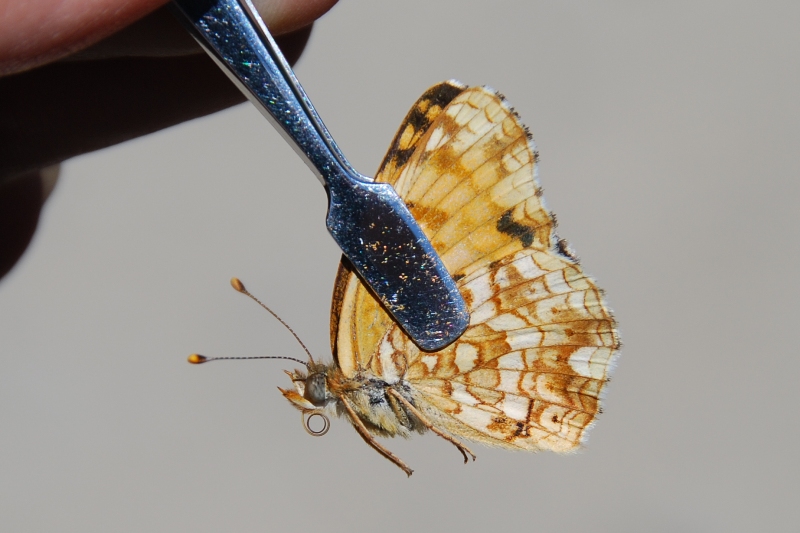
Phyciodes pallida - pale crescent (new record for the SWA!)
Euphydryas anicia - anicia checkerspot
Polygonia satyrus - satyr anglewing
Nymphalis antiopa - mourning cloak
Limenitis lorquini - Lorquin's admiral
Coenonympha tullia - ochre ringlet
Cercyonis pegala - common wood nymph
Erebia epipsodea - Butler's alpine
Total = at least 37 species
View of the valley looking north
Conners Lake, looking southeast
Hooded merganser and company!
Bitterroot
showy milkweed
pale crescent, Phyciodes pallida
northern cloudywing

Tuesday, June 28, 2011

Reecer Creek - June 26

On Sunday, I took my family up Reecer Creek for my first real butterfly-outing in the northwest this year.  The weather was great, no wind, clear, and temperatures ranging from 68 to 74 (according to my car anyway!).  This spring seemed to be just as wet as last year, but was a bit warmer.  I was happy to tally a good list of butterfly species and abundance, as well as observe most of the flowers seemingly blooming "on time".  Thanks to my mom for writing the list as I called out names and numbers from across streams and meadows!
Dreamy duskywing - Erynnis icelus - 1
Western branded skipper - Hesperia colorado - 2
Sara orangetip - Anthocaris sara - 5 m
Cabbage white - Pieris rapae - 1 m
white - Pontia sp. ? - 1
sulphur - Colias sp. - 1
Mountain parnassian - Parnassius smintheus - 2 m
Indra swallowtail - Papilio indra - 1
Two-tailed swallowtail - Papilio multicaudatus - 2 m
Western tiger or two-tailed swallowtail - Papilio sp. (yellow) - 1
Pale tiger swallowtail - Papilio eurymedon - 11+
Lilac-bordered copper - Lycaena nivalis - 2 m, 1 f
Western tailed blue - Cupido amyntula - 4 m, 1 f
Echo blue - Celastrina echo - 15 m, 1 f
Silvery blue - Glaucopsyche lygdamus - 3 m, 1 f
unnamed blue - Euphilotes (on heracleoides) - 5 m, 1 f
Columbia blue - Euphilotes columbiae - 3 m
Boisduval's blue - Plebejus icarioides - 30 m, 4 f
acmon/lupine blue - Plebejus acmon/lupini - 1 m
Zerene fritillary - Speyeria zerene - 1 m, 1 f
Callippe fritillary - Speyeria callippe - 3 m
Coronis fritillary - Speyeria coronis - 10 m, 2 f
fritillary "fly-by"s - Speyeria sp. - 23 (likely all coronis)
Western meadow fritillary - Boloria epithore - 1 m
Hoffman's checkerspot - Chlosyne hoffmanni - 6
Snowberry checkerspot - Euphydryas colon - 200+ (all male with at least one or two female)
satyr or hoary anglewing - Polygonia sp. - 2
Milbert's tortoiseshell - Aglais milberti - 2
Ochre ringlet - Coenonympha tullia - 4
26 species total, with one more possible if the unknown white was not a cabbage white.

View of Kittitas Valley from one of the meadows along Reecer Creek
Bitterroot
Wild onion (Allium sp.) and desert parsley (Lomatium sp.)
Milbert's tortoiseshell - Aglais milberti
Milbert's tortoiseshell larvae on stinging nettle
Echo blues (two in background) and Boisduval's blues (two in foreground)
Columbia blue - Euphilotes columbiae
Hoffman's checkerspot - Chlosyne hoffmanni 
Coronis fritillary - Speyeria coronis
Snowberry checkerspot - Euphydryas colon 
Snowberry checkerspot on arrowleaf balsamroot
Snowberry checkerspots on arrowleaf balsamroot
Snowberry checkerspots puddling
Snowberry checkerspot larva on showy penstemon
All photos are copyright Caitlin C. LaBar

Friday, June 24, 2011

Busy weeks

For the last week I've been travelling hither and yon with my sister, shopping and sight-seeing and visiting good friends, all before she ships off to a remote island to forecast weather for an army base.  This weekend I plan to get up in the hills and hopefully find some butterflies, and will post about that when I get back.  Next weekend I'm planning on another trip, this time to a wildlife area to do some butterfly surveying and photography.
Last weekend I saw my first two tiger swallowtails on the way up to Mt. St. Helens, and then while visiting our close friends in Sequim, we went for a walk at Dungeness Wildlife Refuge (on the beach) where I saw a Lorquin's admiral coast by in the parking lot.  Earlier this week my very first royal walnut moth (aka regal moth or hickory horned devil... because of the six-inch long spiked caterpillar) emerged, much to my delight!  These are tricky to get them to emerge after overwintering, and the first two I had died because I think I got them too cold. This one overwintered in my outdoor storage closet that contains my water heater, so it stayed above freezing but was colder than the house, and was also slightly more humid.
On top of the Space Needle overlooking Seattle
Royal Walnut moth - Citheronia regalis

Tuesday, June 14, 2011

Ant tending

Myrmecophily is the mutualistic association of ants with other organisms.  The larvae of many species of Lycaenidae (family of blues, coppers, and hairstreaks) are tended by ants.  The relationship between the ants and butterfly larvae varies depending on the species, but it is usually mutually beneficial, where the ant protects the larva from predators and parasites, and the larva provides a sugary substance high in amino acids that the ants love.  In the Pacific Northwest, ants are commonly associated with larvae of silvery blue (Glaucopsyche lygdamus), Boisduval's blue (Plebejus icarioides), and echo blue (Celestrina echo) butterflies, among others.
Following are photos of thatch ants (Formica sp.) tending Puget blue larvae (Plebejus icarioides blackmorei), a subspecies of the Boisduval's blue.
(1) ant "tickling" the larva with its antennae
(2) larva protruding organs that produce a nectary substance
(3) ant consuming "nectar"
Series of photos on the left show ants "herding" mature larva into a tunnel at the base of a lupine plant.  Photos on the right show the larva in the hole the next day, slightly curled up, possibly preparing to pupate.  I uncovered the larva to take the photo, and replaced the moss and sticks when I was done.
Following photos show unidentified ants tending larvae of the federally endangered Fender's blue (Plebejus icarioides fenderi), another subspecies of the Boisduval's blue.  Both photos were taken at the base of a lupine plant.

Silvery blue larvae (Glaucopsyche lygdamus) usually feed on lupine flowers and are colored pink and purple, compared to Boisduval's blues which feed on leaves and stems and are colored green.
Silvery blue larva on lupine flower stalk
Silvery blue larva tended by several unidentified ants

Thursday, June 2, 2011

Species Profile: Hemileuca eglanterina - Elegant Sheepmoth

The first adult emerged today (June 2) from the group of caterpillars I collected last year in the Manastash hills southwest of Ellensburg, WA.  I wasn't sure if they were going to be Hemileuca nuttalli or H. eglanterina, as both feed on bitterbrush and look very similar.  It turned out to be the latter, and I can't wait for the rest of the adults to emerge!  These moths fly during the day and look like clumsy but fast-moving butterflies when they zip past.  In higher elevations and cooler climates, they can take two years to complete their life cycle, overwintering as eggs and pupae. Adults emerging in mid- to late-summer lay eggs that overwinter and hatch in April or May.  Larvae feed for several weeks through the summer, then burrow into the ground and pupate in July or August. Adults then emerge the next year to start the cycle over again.
Larvae of all Hemileuca species have urticating spines, which means that they emit a chemical that irritates anything that touches the spines, causing an annoying rash or stinging pain depending on the level of contact.  The pain can last up to a half hour (personal experience!).

I have reared H. eglanterina four times from different locations in Washington. They are known to feed on a variety of shrubs. I have found larvae on rose (Rosa eglanteria or R. woodsii), snowberry (Symphoricarpos spp.), serviceberry (Amelanchier alnifolia) and bitterbrush (Purshia tridentata) and the larvae from all of those hosts readily moved between them in all larval stages.

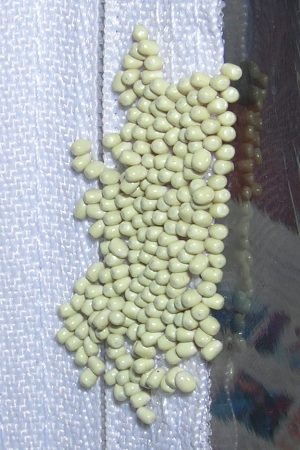
Here are photos of the complete life cycle of the Elegant Sheepmoth/Buckmoth, Hemileuca eglanterina.  The eggs are from a female I found several years ago (she laid them on the inside of the cage zipper!), the rest of the photos are of the group I found last year, ending with the adult male that emerged today.
Hemileuca eglanterina eggs